arXiv · Computer Vision
2025
BleedOrigin
Dynamic Bleeding Source Localization in Endoscopic Submucosal Dissection via Dual-Stage Detection and Tracking
The Chinese University of Hong Kong · CUHK Shenzhen Research Institute · Qilu Hospital of Shandong University
From onset to hemostasis
Detect the first bleed.
Keep the source in sight.
BleedOrigin connects two tasks that are usually studied separately: prompt bleeding-onset detection and continuous source tracking.
Predicted source
Bleeding alert
TL;DR
BleedOrigin gives endoscopists an early warning when bleeding starts, identifies its exact origin, and keeps tracking that point through blood, flushing, reflection, camera motion, and instrument interference.
Clinical problem
A few milliseconds before the source disappears.
During ESD, blood can rapidly obscure the field. Endoscopists often flush repeatedly to regain only a brief view of the true source.
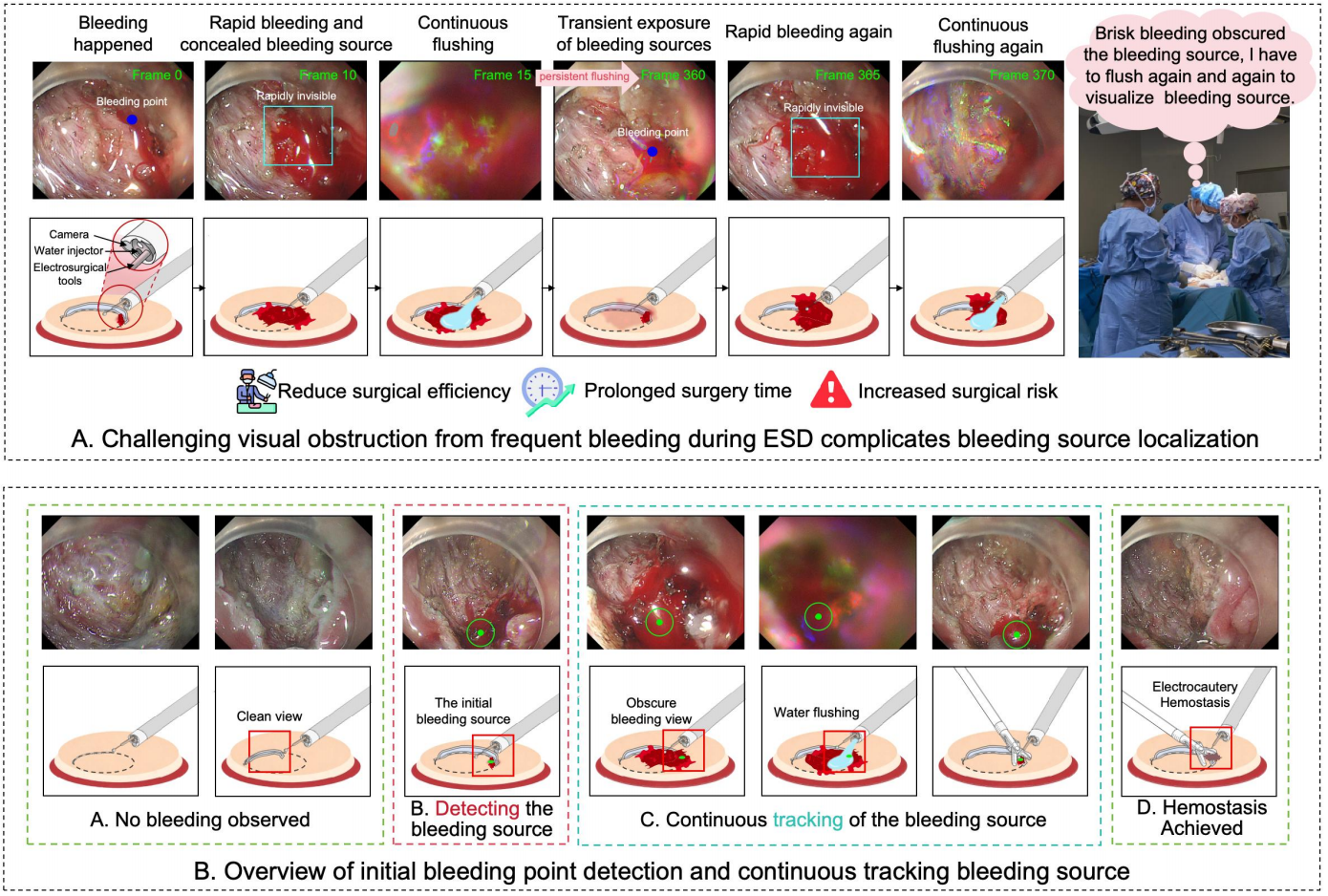
The source is briefly visible in a dynamic endoscopic scene.
Blood, smoke, reflection, or instruments hide visual evidence.
The clinician repeatedly clears the field to relocate the point.
An alert and a persistent location guide the next intervention.
BleedOrigin-Bench
A benchmark designed around the complete bleeding event.
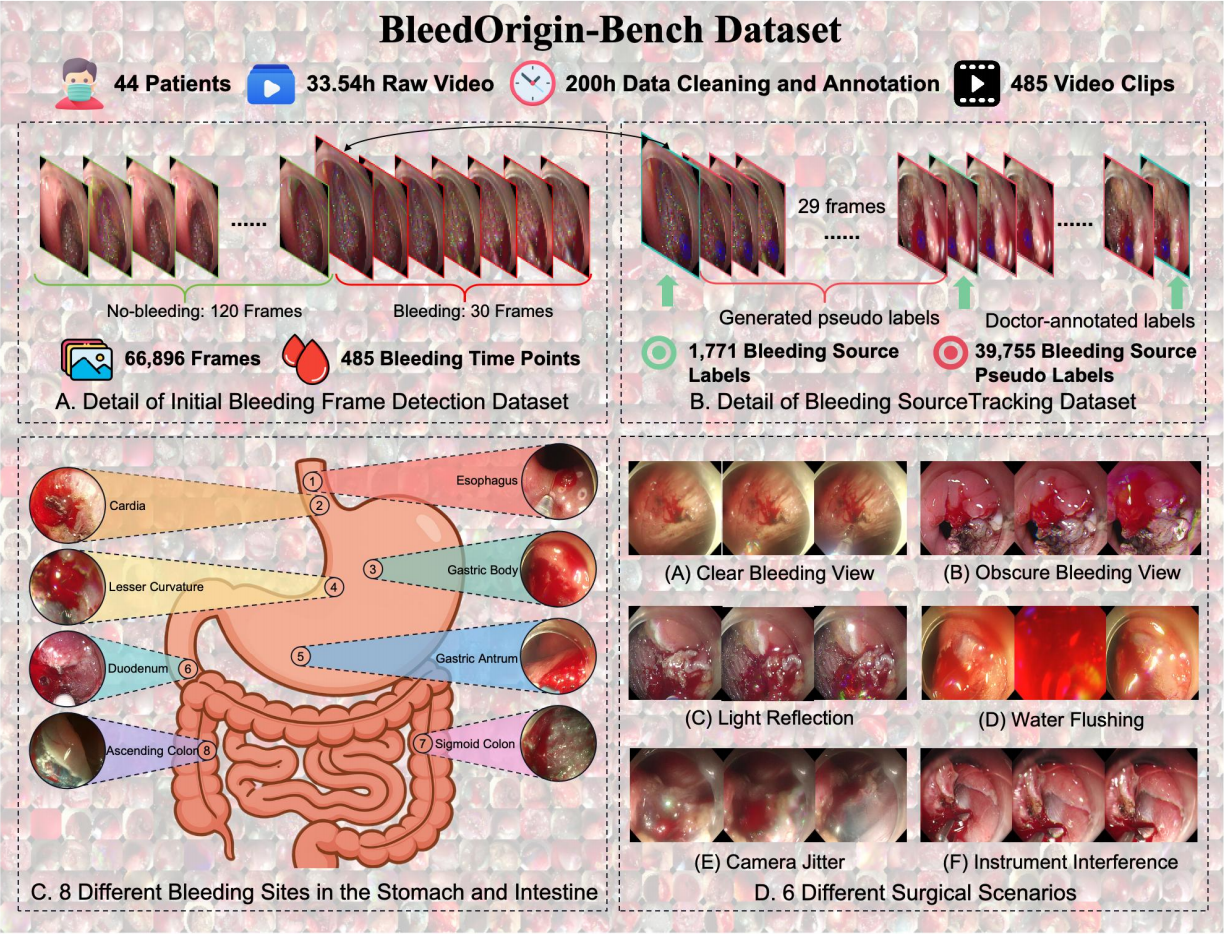
From the first bleeding frame to long-term point tracking, the benchmark captures both when bleeding begins and where it comes from.
Onset detection
66,896 frames
485 clinically annotated bleeding time points.
Source tracking
1,771 expert labels
Plus 39,755 dense pseudo-labeled frames.
Clinical diversity
8 anatomical sites
Collected from 485 clips across 44 procedures.
BleedOrigin-Net
One pipeline, two coordinated stages.
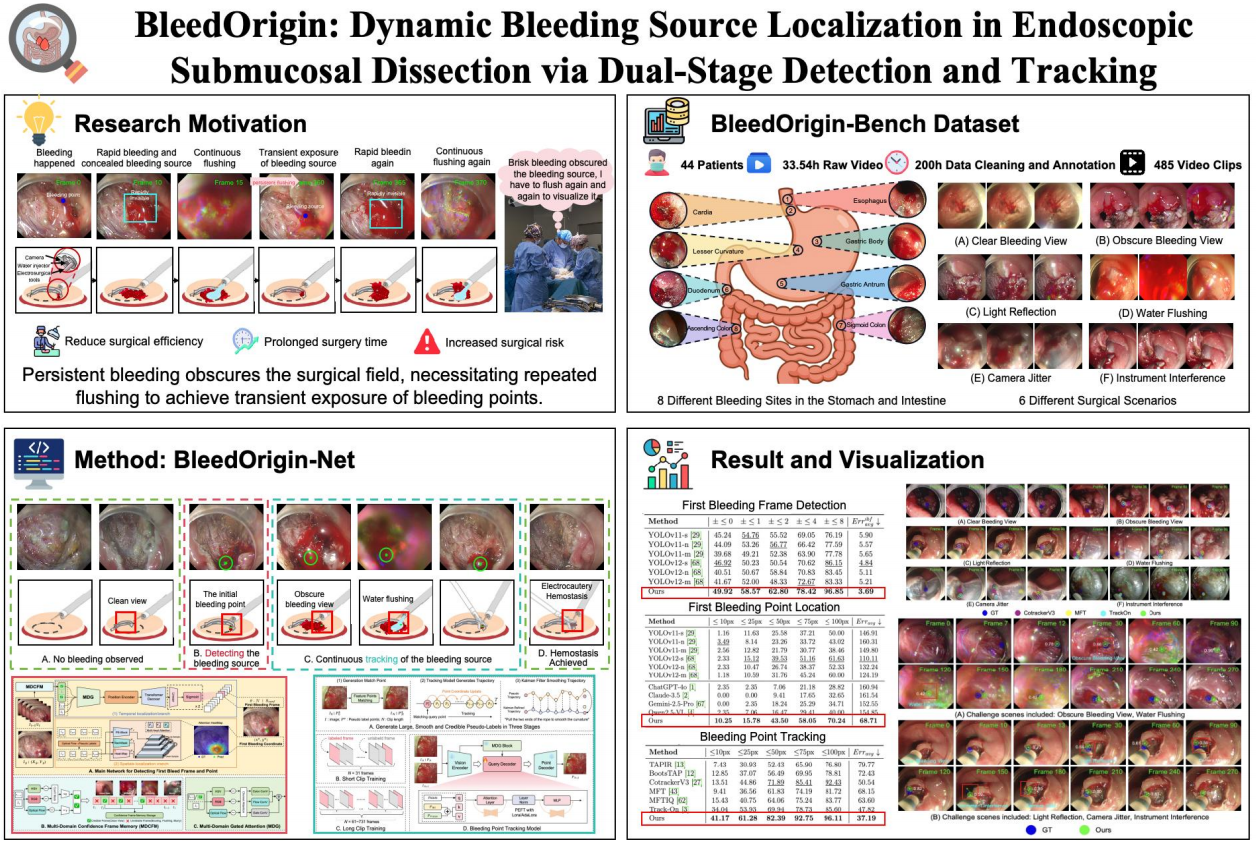
The first stage recognizes the onset and localizes the source. The second maintains that location through the rest of the event.
Stage 01
Detection
Recognize onset. Pinpoint origin.
Multi-Domain Confidence-based Frame Memory builds temporal context from complementary RGB, HSV, and optical-flow cues.
- MDCFM multi-domain frame memory
- Multi-Domain Gated Attention
- Frame-level onset and pixel-level source prediction
Stage 02
Tracking
Follow the point through change.
Sparse expert annotations are expanded into dense supervision with feature matching, trajectory prediction, and Kalman filtering.
- Pseudo-label enhanced training
- Memory refresh for re-identification
- Parameter-efficient LoRA fine-tuning
State-of-the-art performance
Accurate at the moment of onset—and afterward.
Onset detection
Frame-level accuracy within ±8 frames.
Initial localization
Pixel-level accuracy within 100 pixels.
Continuous tracking
Pixel-level accuracy within 100 pixels.
Evaluated against YOLOv11/v12, multimodal large language models, and point-tracking baselines.
Six surgical scenarios
Localization when the visual evidence changes.
Select a scenario to inspect predictions under common ESD disruptions.
Scenario 01
Clear bleeding view
A visible source provides the reference case for prompt onset localization and stable tracking.
Prediction
Ground truth
Clinical deployment study
Alert first. Re-identify when evidence returns.
In high-difficulty deployment footage, copious flushing may cause temporary tracking drift. The memory-refresh strategy supports source re-identification once visual features reappear.
Real-time bleeding state
Pulsating source alert
Memory-based recovery
What this work contributes
From a segmentation problem to a clinical workflow.
A new benchmark
Expert labels and dense pseudo-labels for onset, origin, and continuous tracking across diverse ESD cases.
A dual-stage network
Multi-domain temporal memory for detection, followed by efficient point tracking with recovery.
A deployment-oriented task
The system is designed around the path from early warning to hemostatic intervention, not a single isolated frame.
Publication
BleedOrigin
Dynamic Bleeding Source Localization in Endoscopic Submucosal Dissection via Dual-Stage Detection and Tracking
- Year
- 2025
- Archive
- arXiv
- ID
- 2507.15094
- Class
- cs.CV
BibTeX
@misc{xu2025bleedorigin,
  title  = {BleedOrigin: Dynamic Bleeding Source
            Localization in Endoscopic Submucosal
            Dissection via Dual-Stage Detection
            and Tracking},
  author = {Xu, Mengya and Zhou, Rulin and Wang, An
            and Lyu, Chaoyang and Li, Zhen and
            Zhong, Ning and Ren, Hongliang},
  year   = {2025},
  eprint = {2507.15094},
  archivePrefix = {arXiv},
  primaryClass  = {cs.CV}
}