Non-rigid motion
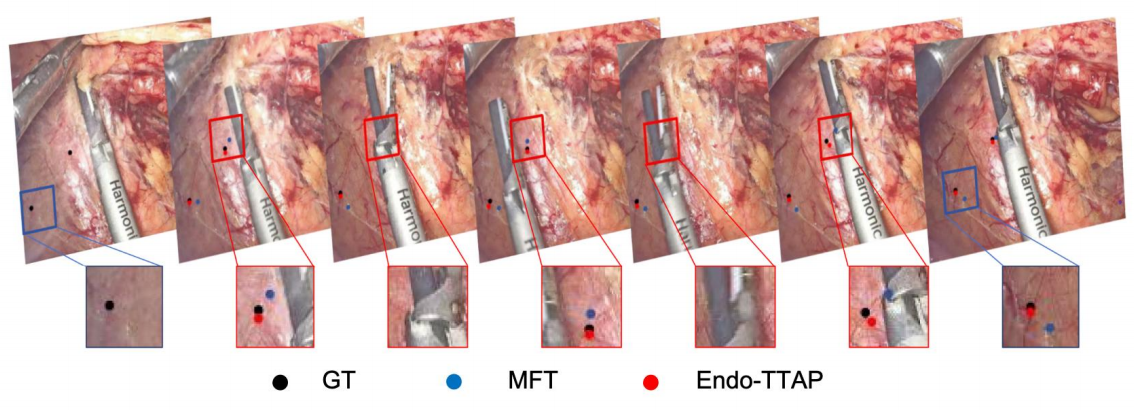
The same tissue point moves with deformation—not as a rigid object.
Endoscopic tissue point tracking
Endo-TTAP combines motion, semantics, and uncertainty with a two-stage flow-point supervision strategy—keeping trajectories reliable through deformation, occlusion, jitter, reflection, and smoke.
REN Lab and collaborators · Shenzhen, Hong Kong
The tracking gap
Surgical tissue rarely behaves like an ordinary video benchmark. It stretches, leaves the field of view, hides behind instruments, and changes appearance in seconds. Dense manual trajectories are also costly to annotate.
The same tissue point moves with deformation—not as a rigid object.
Instruments, glare, and smoke can erase reliable appearance cues.
Expert trajectory labels are valuable, but too scarce for direct scaling.
Our approach
Endo-TTAP turns complementary weak signals into one robust tracking system.
Synthetic initialization
Supervised flow ground truth builds a stable motion representation before entering the surgical domain.
Surgical adaptation
Flow consistency and pseudo-point trajectories reduce dependence on sparse manual annotations.
ACA
An exponential schedule progressively bridges synthetic flow and real surgical appearance.
MFGA
Fuses multi-scale flow, DINOv2 semantics, and motion patterns to predict position, visibility, and uncertainty.
PLG
Combines segmentation, feature anchors, two trackers, and trajectory filtering to create dense supervision.
Endo-TTAPC5
250 endoscopic video segments organized around five clinically meaningful challenges—not just average motion.
Challenge-aware evaluation makes it easier to see where a tracker fails and why.
Benchmark snapshot
Selected results below are reported in the public arXiv v1 preprint. The IEEE TMI manuscript is currently under minor revision.
Rob3D with 0.9 ± 0.8 mm 3D tracking error.
Lower endpoint error with 0.784 2D accuracy.
Performance on the challenge-oriented preprint benchmark.
v1 The preprint uses “Endo-TAPC5”; the revised project uses “Endo-TTAPC5”.
Visual comparison
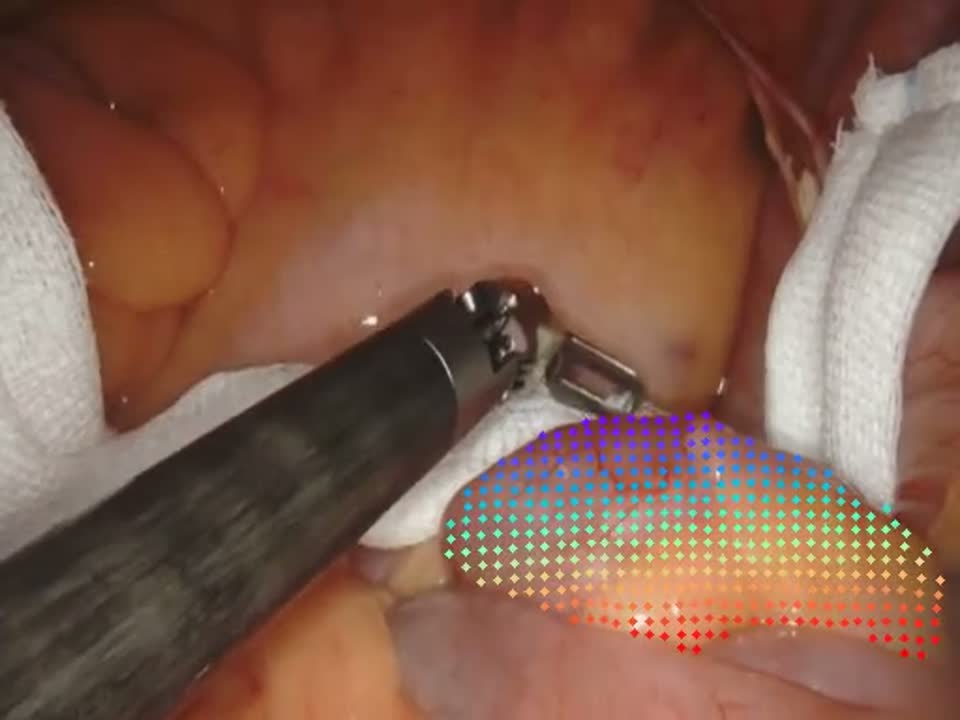
Non-rigid tissue motion tests whether tracked points follow anatomy rather than a rigid image pattern.
Blue: baseline trajectory · Red: Endo-TTAP trajectory
Explore the work
The public preprint and website code are available now. Journal review is ongoing.
@article{zhou2025endottap,
  title   = {Endo-TTAP: Robust Endoscopic Tissue
             Tracking via Multi-Facet Guided Attention
             and Hybrid Flow-point Supervision},
  author  = {Zhou, Rulin and He, Wenlong and Wang, An
             and Yao, Qiqi and Hu, Haijun and Wang,
             Jiankun and Zhang, Xi and Ren, Hongliang},
  journal = {arXiv preprint arXiv:2503.22394},
  year    = {2025}
}